
Commercial Real Estate Made Simple
What Are CAM Charges in Commercial Real Estate?
A practical guide to common-area maintenance charges, what CAM may include, how costs are allocated, and what tenants should review before signing a commercial lease.
CAM Means “Common Area Maintenance”
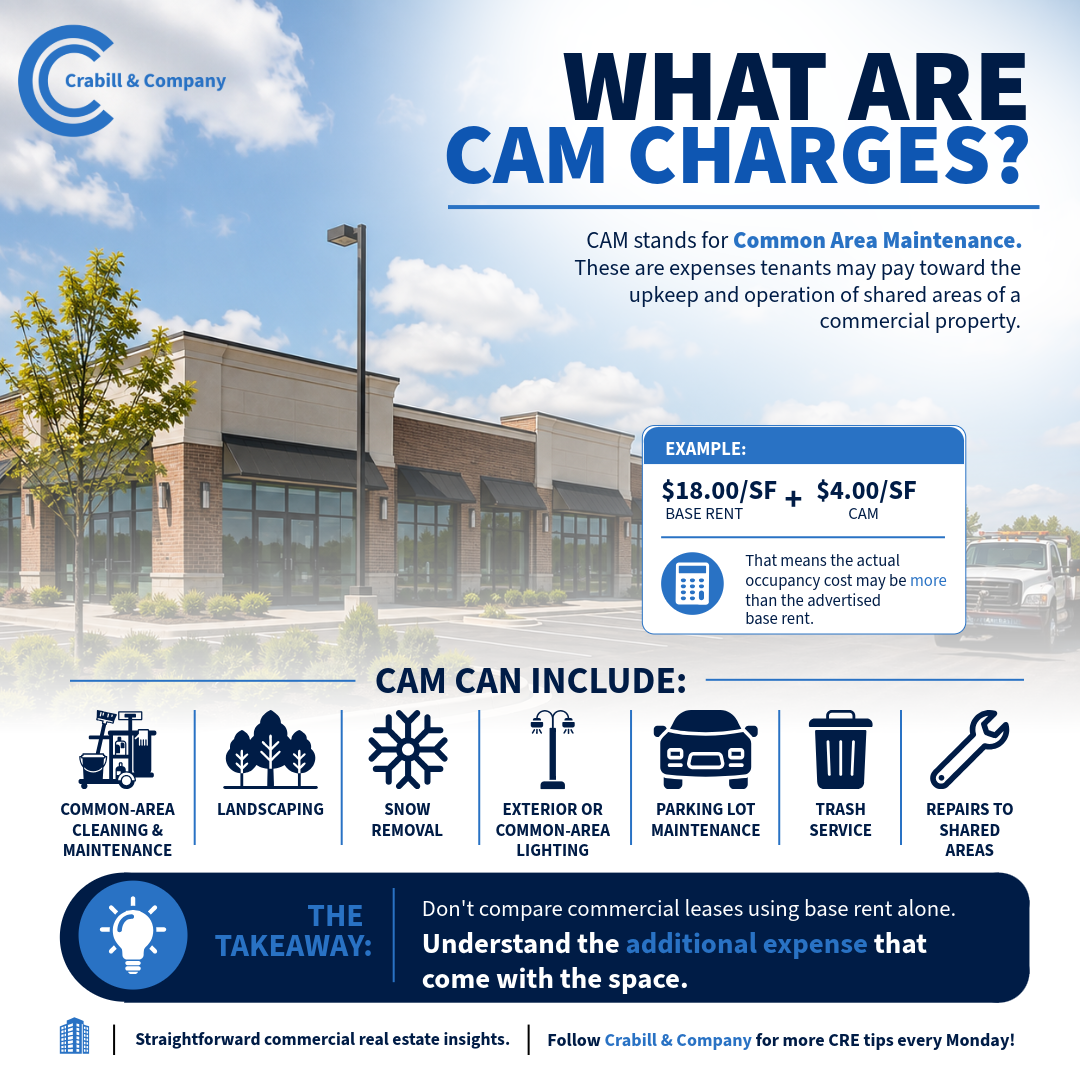
In commercial real estate, CAM stands for common area maintenance. CAM charges are expenses associated with operating, maintaining, and servicing portions of a commercial property that benefit multiple tenants or the property as a whole.
CAM charges are especially common in multi-tenant retail properties, office buildings, industrial properties, and warehouse properties.
What Can CAM Charges Include?
The exact definition varies from lease to lease and property to property. Depending on the building, CAM expenses may include costs such as:
- Parking-lot maintenance and repairs
- Snow removal and salting
- Landscaping and lawn care
- Exterior lighting
- Common-area electricity or utilities
- Shared hallway, lobby, or restroom maintenance
- Trash removal
- Common-area cleaning or janitorial service
- Security services or systems
- Property management or administrative expenses, when allowed by the lease
- Routine maintenance of shared building systems or exterior areas
Some leases define CAM narrowly, while others use a broader operating-expense definition. That is why tenants should review the actual expense categories instead of relying only on the term “CAM.”
How Are CAM Charges Calculated?
In many multi-tenant properties, tenants pay a pro-rata share of eligible common-area expenses. The tenant’s share may be based on its leased square footage compared with the total rentable square footage of the property or another allocation method defined in the lease.
Simple CAM Example
Assume a tenant leases 5,000 square feet in a multi-tenant commercial property. The landlord estimates CAM charges at $4.75 per square foot per year.
In this simplified example, the tenant would pay approximately $23,750 per year, or about $1,979 per month, in estimated CAM charges. This would normally be in addition to base rent and any other expenses required by the lease.
CAM Charges vs. NNN Charges
CAM and NNN are related concepts, but they are not interchangeable. If you have not read it yet, see our guide to what NNN means in commercial real estate.
| Expense | CAM | NNN / Triple Net |
|---|---|---|
| Common-area maintenance / operating costs | Typically the main focus. | Often included as one of the expense categories. |
| Property taxes | May be separate from CAM depending on lease terminology. | Typically one of the three “nets.” |
| Building insurance | May be separate from CAM depending on lease terminology. | Typically one of the three “nets.” |
| Base rent | Separate from CAM. | Separate from NNN reimbursements. |
Are CAM Charges Fixed?
Usually not. CAM charges are often billed as monthly estimates and then reconciled against the property’s actual eligible expenses. If actual costs are higher than the estimates, the tenant may owe an additional amount. If actual costs are lower, the tenant may receive a credit or adjustment depending on the lease.
Because expenses such as snow removal, utilities, maintenance, and vendor costs can change, CAM charges may vary from year to year.
What Is a CAM Reconciliation?
A CAM reconciliation compares the amount a tenant paid during the year with the tenant’s share of the property’s actual eligible expenses. The landlord typically calculates the final amount after the end of the accounting period.
Tenants should understand when reconciliations occur, what supporting information is available, how adjustments are handled, and whether the lease provides any review or audit rights.
What Is a CAM Cap?
A CAM cap can limit how much certain controllable operating expenses may increase from year to year. Whether a cap exists, which expenses it applies to, and how the cap is calculated depends entirely on the lease.
Some expenses may be excluded from a cap because they are considered uncontrollable, such as certain utility costs, government charges, or other categories specified by the lease.
What Should a Tenant Review Before Signing?
CAM language can have a meaningful effect on total occupancy cost. Before signing a commercial lease, tenants should understand more than just the current CAM estimate.
- Current CAM estimate: What is the current per-square-foot or monthly estimate?
- Historical CAM expenses: How have costs changed over the last several years?
- Included expenses: Exactly which expenses can be passed through?
- Excluded expenses: Are major capital items, landlord-specific costs, or other categories excluded?
- Pro-rata share: How is the tenant’s percentage calculated?
- Management fees: Is a management or administrative fee included?
- CAM caps: Are increases in controllable expenses limited?
- Reconciliation timing: When will the tenant receive the annual reconciliation?
- Audit or review rights: Does the lease allow the tenant to review supporting expense records?
Why CAM Matters When Comparing Commercial Spaces
Two properties can have similar asking rents but very different total costs after CAM and other pass-through expenses are included. A tenant comparing locations should therefore evaluate the entire occupancy cost rather than simply choosing the lowest advertised base rate.
Businesses looking for space can browse Crabill & Company’s current commercial real estate listings and compare each property based on location, size, building features, lease structure, and total cost.
How a Commercial Real Estate Broker Can Help
A commercial real estate broker can help tenants compare asking rents, estimated CAM charges, NNN expenses, building features, location, and other lease considerations before choosing a property.
Crabill & Company provides commercial real estate brokerage services for businesses, property owners, investors, and developers throughout Michigan.
CAM Charge FAQs
What does CAM stand for in commercial real estate?
CAM stands for common area maintenance. It generally refers to expenses associated with maintaining and operating shared portions of a commercial property.
Is CAM included in rent?
It depends on the lease structure. In some leases CAM is billed separately from base rent, while in other lease structures some operating costs may be bundled into the stated rent.
Is CAM the same as NNN?
No. CAM may be one component of a triple-net lease. NNN commonly refers to property taxes, building insurance, and operating or common-area expenses.
Can CAM charges increase every year?
Yes. Actual maintenance and operating costs can change from year to year. Some leases include caps on certain controllable expenses, while others do not.
What is CAM reconciliation?
CAM reconciliation is the process of comparing estimated CAM payments with the tenant’s share of actual eligible property expenses for the year.
Comparing Commercial Space in Michigan?
Browse current Crabill & Company listings or contact our team to discuss your space requirements, preferred market, building needs, and lease structure.